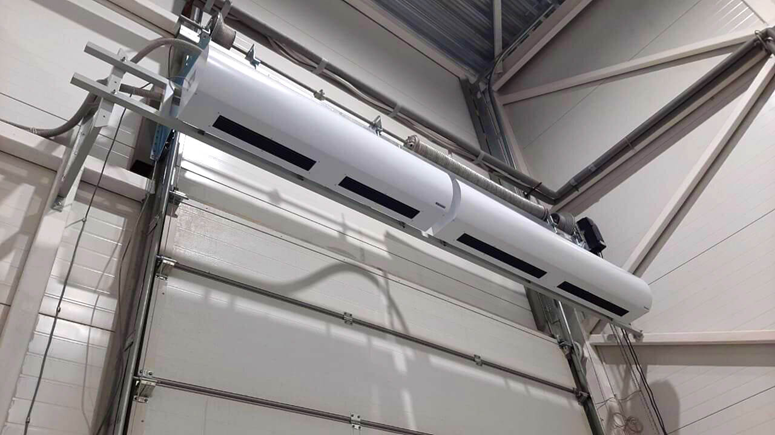

The thermal curtain helps to retain heat in the room, reduces drafts and reduces energy losses through open doors. The effect is especially noticeable in shops, offices, warehouses and private houses with a vestibule or an entrance group.
The quality of the curtains from https://friros.fi depends not only on the power, but also on the correct installation: installation height, direction of flow, accuracy of fastening and compatibility with the power supply. Below are practical rules that will help you avoid common mistakes.
Choosing the location and type of thermal curtain
The main rule: the air flow must cover the opening over the entire width and form a «barrier» at the street/premises border.
Where to install
- Above the doorway is the most common option for horizontal models.
- On the side of the opening — for vertical models when there is no space above (low ceilings, signs, structural restrictions).
- In the vestibule is convenient for private houses and objects with double doors: the curtain works more smoothly, heat loss when opening the outer door is reduced.
How to choose length and productivity
The length of the curtain should be equal to the width of the opening or a little more. If the opening is wide, two curtains are often placed close together so as not to leave «gaps» at the edges.
The air performance is chosen taking into account the height of the installation: the higher the installation, the more powerful the flow is needed so that the jet «reaches» the floor and does not fall apart along the way.
Selection of a model for the opening: width, mounting height and required power
The thermal curtain is selected not «by the area of the room», but by the parameters of the opening and installation conditions: width, height of installation, intensity of opening and temperature difference. An error in these initial data almost always leads to the fact that the curtain either does not «hold» the flow and draws cold inside, or it works noisily and consumes more energy than necessary.
Before buying, measure the actual opening (taking into account the platbands/box), clarify whether there is a place for installation, and determine the type of curtain (electric or water), as well as the orientation (horizontal above the opening or vertical on the side). Next, choose the length of the case, the permissible height of the installation and the approximate heating power for your scenario.
Key selection parameters
1) Opening width > the length of the curtain
The length of the housing should cover the opening completely so that the air flow forms a continuous «screen» without side suctions.
- Rule: the length of the curtain = the width of the opening or 50–100 mm more.
- If the opening is wide and there is no model of the required length, put 2 curtains butt-to-toe (without a gap) or choose a vertical scheme.
- For openings with a complex geometry (hallway, double doors), it is more important to «close» precisely the suction area: sometimes two shorter curtains are more effective than one «buttock».
2) Installation height > required performance (speed/air consumption)
The height of the installation determines whether the stream will be able to «reach» the floor and maintain sufficient speed to cut off the outside air. If the curtain is designed for a lower height, it will «sag» and work like a regular fan above the door.
- Choose a model in which the permissible mounting height is not lower than your actual height (preferably with a small margin).
- The higher the installation, the more critical is the correct adjustment of the flow direction (usually with a slight outward slope) and the absence of obstacles (visors, beams, lamps in the emission zone).
- For constant drafts and «wind load» (exit to the street without a vestibule), focus on models with increased productivity and several speed levels.
3) Required heating power > comfort, not «blocking» the cold
It is important to separate two functions: the cutout provides air flow (performance), and comfort at the entrance provides heating. In some cases, a curtain without heating (or with minimal heating) is enough, especially if the room is already well heated.
How to estimate the heating power
- Determine the type of opening: internal door / street with vestibule / street without vestibule.
- Rate the intensity: infrequent openings / constant traffic / door open for a long time.
- Choose heating according to the task: comfort at the entrance (warmer) or loss minimization (moderate).
- Set up step control (2-3 heating modes and 2-3 fan speeds) to adapt to the weather and the flow of people.
Result
The correct selection of a thermal curtain begins with the geometry of the opening: the length overlaps the width, the model allows for your installation height, and the heating power corresponds to the scenario (street/vestibule, frequency of opening, comfort requirements). If you are in doubt between «stronger heating» and «stronger flow», the flow and height of the installation will almost always be decisive: they determine whether the curtain will really cut off the cold.